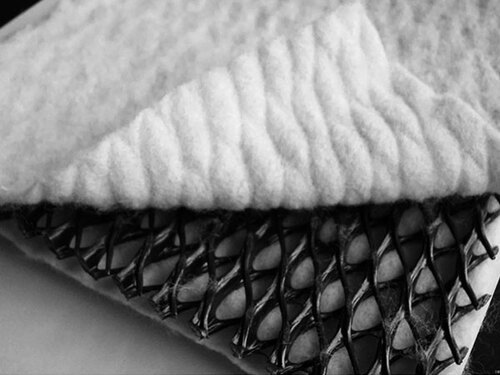
Composite drainage geonet
The composite drainage net (also known as three-dimensional composite drainage net, tunnel drainage board, and drainage board) is composed of a three-dimensional plastic net with permeable geotextile bonded on both sides. It can replace the traditional sand and gravel layers and is mainly used for drainage in landfill sites, roadbeds, and the inner walls of tunnels. In transportation infrastructure such as railways and highways, the service life of the project is closely related to its own drainage system, among which geosynthetic materials are an important component of the drainage system.
Product Features
Highly efficient drainage, with a flow rate 5 to 8 times that of traditional gravel layers, and stable water conduction under high pressure. It has excellent strength, strong bidirectional tensile and compressive resistance, and can reduce subgrade settlement and pavement cracks. Weather-resistant and durable, resistant to acid and alkali aging, suitable for extreme temperature zones and with a service life of over 50 years. Convenient construction, simplified process, shortened construction period and reduced cost. Environmentally friendly, recyclable and adaptable to multiple engineering scenarios.
Execution Standards
CJ/T 452-2014 "Geosynthetic Drainage Nets for Landfill Sites"
Applicable Range
It is mainly used in drainage projects such as railways, highways, tunnels, municipal engineering, reservoirs and slope protection, and has a very good effect.
Product Specifications
The thickness of the mesh core is 4mm-8mm. Width: 2m-6m; The weight per layer of geotextile is generally 200g. The length is according to the user's requirements.